
Nearhuman develops edge AI for the physical world
Bristol-based Nearhuman is developing edge AI that lets machines see, decide and act in real time without relying on a cloud connection.

A vision-based safety system
Its first application aims to improve e-scooter safety on UK streets. It is the third start-up for founder and CEO Faizan Mir, a UWE robotics graduate from Kashmir: he launched his first at 16, and his second built self-driving delivery vehicles for the Himalayas before he even reached university.
With support from Innovate UK Business Growth, delivered by Business West in the South West, Nearhuman has secured £350,000 in investment, won Frontier AI grant funding and launched a Catapult-supported project to take its technology closer to market.
A vision-based safety system
E-scooters are now a familiar sight in UK cities, but riding on the pavement remains a persistent problem, and there were 1,477 casualties in collisions involving e-scooters in Great Britain in 2025. In July 2026, the Motor Insurers’ Bureau reported that the total incurred cost of micromobility compensation claims had exceeded £100 million since 2019.
Nearhuman's answer is a vision-based safety system designed to retrofit onto existing e-scooters and e-bikes. Using computer vision similar to the technology found in self-driving cars, the system aims to tell whether a rider is on the road or the pavement, recognise risky riding behaviour and slow vehicles down accordingly.
The system can also collect location-tagged road-condition data, including potholes, which could help councils identify and prioritise repairs.
Micromobility is Nearhuman’s first application, but the company’s core technology is edge AI: running AI models directly on a device rather than in the cloud, so decisions can be made in real time without relying on a network connection.
“You can't depend on the cloud in critical situations because of latency, so the models have to run on board so you can make decisions in real time. Edge AI is the area the company is working on more and more,” Faizan explains.
Joined-up support
Nearhuman began working with Innovate UK Business Growth in late 2025. Innovation and Growth Specialist Gillian Montanaro helped build a detailed growth plan focused on product development, commercialisation, team and funding.
“Gillian's on it. I love how she takes all of these notes and brings the puzzle pieces together. Every time I have a meeting with her, there's progress and new support opportunities come up,”
Grant and investment success
Gillian identified Innovate UK’s Frontier AI Discovery grant as a potential avenue for Nearhuman, and grant specialist Susie Williams stepped in to review the application.
“The feedback I got from Susie made it much clearer where we were lacking and what assessors look for. Our application was successful, and we’re now using the grant to research how to optimise AI models so they can run on edge devices,” says Faizan.
To prepare for fundraising, Gillian introduced investment specialist Alison Briggs to carry out a detailed review of the company’s pitch deck. She also provided opportunities to pitch at a Digital Technologies and AI Pitch Panel in November 2025 and to access Beauhurst investor list reports to help identify suitable investors. After attracting strong investor interest, the company closed a £350,000 pre-seed round led by SFC Capital.
“I used to run my pitch decks through ChatGPT, Claude and other AI models, and they would just give me generic advice. When Alison went through it, the advice was invaluable. Her specific, practical feedback made a real difference,” says Faizan.
Clearer marketing, smarter decisions
To make sure Nearhuman’s website showed visitors what they needed to see, digital marketing specialist Angus Ogilvy-Stuart supported the team with audience definition, keyword research, website structure and a digital go-to-market plan. The company has since redesigned and rewritten its website.
The team had also built its own AI-powered SEO tool, originally to manage content and marketing on its own website. It worked so well that they considered releasing it more widely, so Gillian introduced market intelligence specialist Alfie Showumni to analyse the UK market opportunity, giving the board a clear evidence base for its next steps.
“I took that document to my advisors and board members, and we made some critical decisions based on it. Without it, I think we would have wasted a lot of time and resources doing something we shouldn't have been doing,” says Faizan.
Building the next generation of hardware
With Gillian’s support, Nearhuman has also secured RTO / Catapult grant funding for a project with Wyzer Partners to develop and test an integrated edge AI vision control unit for micromobility vehicles.
“We didn't have the internal resources for the technology we wanted to build, so getting external support was critical. The outcome of this project will be critical for the next market opportunity and milestones we're looking at,” says Faizan.
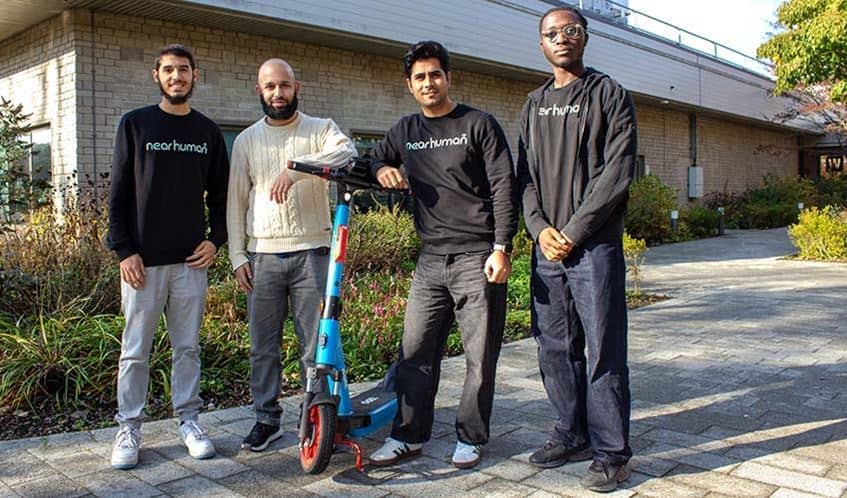
Alongside founder and CEO Faizan Mir, co-founder and COO Ali Ekbal and Nearhuman’s engineering and research team are working to turn the company’s technology into products for real-world use.
Growth and impact
Nearhuman's technology is currently being piloted to collect real-world data and evaluate its performance ahead of wider deployment. By putting AI directly into physical devices, the company aims to help make streets safer for riders and pedestrians, give councils better insight into road conditions and strengthen UK capability in edge AI.
Looking ahead, Nearhuman sees potential applications for its edge AI technology in drones, robotics and other autonomous systems.
“If we hadn't had that support, I think the conversation right now would have been completely different. We wouldn't have made this much progress. It's definitely made a huge difference for us,”