
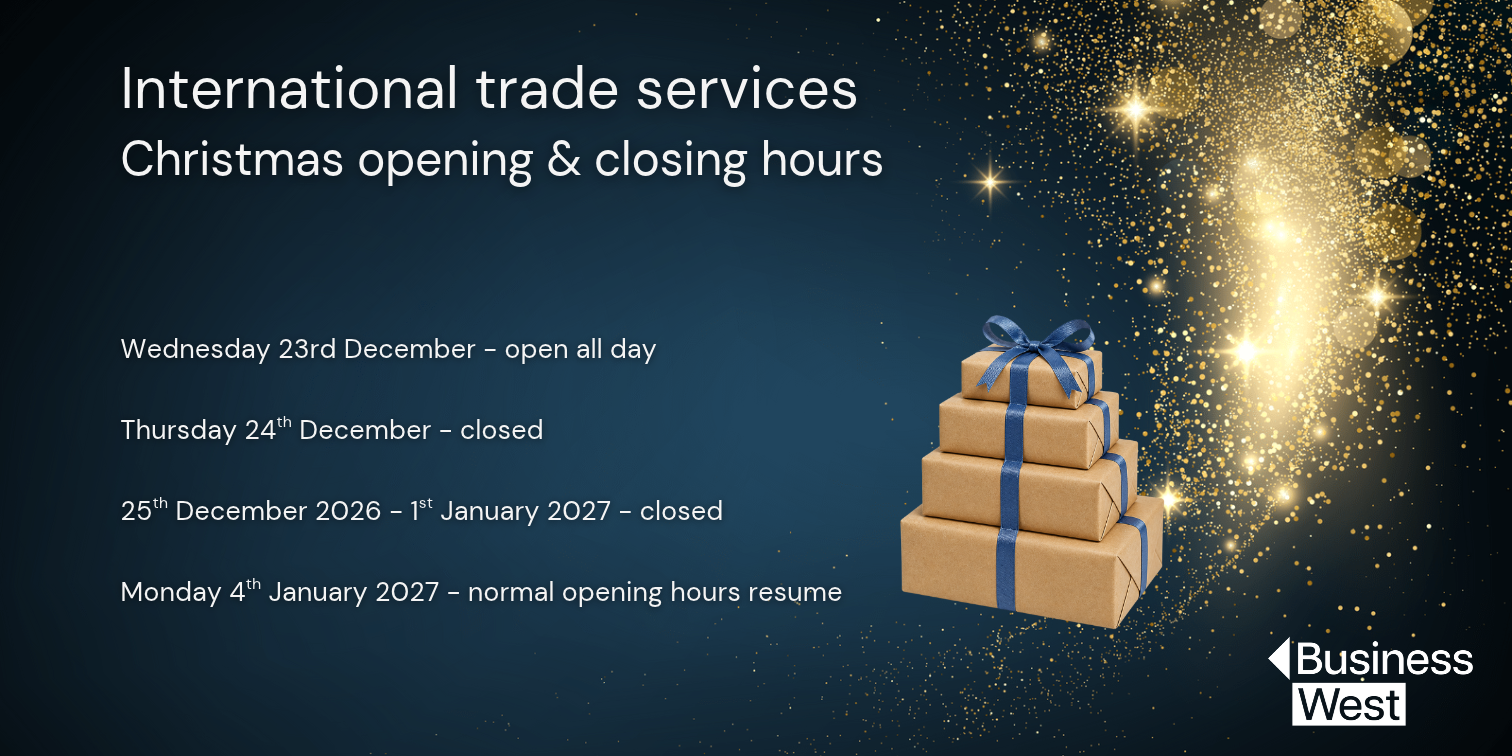
International Trade Services team: Christmas opening and closing hours

Fiona Parsons
24 November, 2026
Business West

Zero percent of surveyed UK exporters say they have “comprehensive support” from government to manage trade policy changes, according to new research by the British Chambers of Commerce (BCC), in partnership with global standards organisation GS1 UK.
The BCC’s Insights Unit surveyed 939 firms – 40% exporters – with 0% of responding businesses saying government was providing comprehensive support on trade policy changes.
Of all firms surveyed, only 13% feel they get sufficient support, while 32% and 31% feel they either have not much support or no support at all, respectively.
Exporters are more likely to say they receive little trade policy support from government. 41% feel they don’t have much support and 32% no support at all. Only 17% say they are getting sufficient support. Again, 0% say they get comprehensive support.
The data comes as the BCC and GS1 UK publish a new report examining how digital trade can help transform economic growth. The report concludes that “standing still on trade digitalisation, e-certification and e-labelling is a manifesto for economic decline”.
The report calls for a joint plan between UK government and business to manage digital trade. The plan focusses on:
"Our research is clear, UK exporters are navigating trade policy changes largely alone. “At a time when the global trade landscape is changing constantly, firms tell us comprehensive support from government is lacking. Many businesses feel they are getting little or no advice. “To help grow the economy and keep the UK competitive, we need a joint plan between government and business to drive forward digital trade. Standing still isn’t an option. “The UK has real strengths in digital trade documentation and world class private sector capability. Those strengths need to be urgently harnessed alongside comprehensive support to exporters across the UK.”
“Fifty years ago, GS1 standards transformed global trade by giving industry a shared language. “Today, we need the same collaborative spirit to prepare businesses for the digital age, from e labelling and digital product passports to electronic documentation. Our research shows UK exporters are being left to navigate this transition largely on their own, without the government support they need. “The private sector and GS1 UK already have world class digital capability. What’s missing is a genuine partnership with government to put the right frameworks in place. Without it, the UK risks falling behind.”
Fiona Parsons
24 November, 2026
Business West

The UK–EU leaders’ summit on 20th November brought some welcome progress, particularly for businesses trading food, animals and plants. The UK and EU have concluded negotiations on new agreements, with the main changes for goods traders expected in 2028.
Fiona Parsons
23 November, 2026
Business West
You’ve agreed the order and arranged delivery. Then your customer asks for a Certificate of Origin. Or perhaps they want evidence that your goods qualify for lower tariffs under a trade agreement. These requests can sound similar, but they serve different purposes. Knowing the difference helps you prepare the right paperwork.
Fiona Parsons
10 November, 2026
Business West