A Customer Relationship Management (CRM) tool is an invaluable asset for any business. It doesn’t matter if you’re in the Fortune 500 or a team of four, CRMs are the first step to embracing a more technologically forward way of doing business.
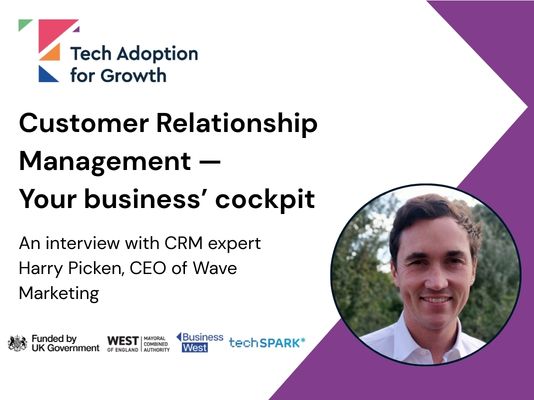
We sat down with Harry Picken, CEO at Wave Marketing, to discuss his more than 10 years of experience with CRMs and how he has helped organisations both big and small make the most of their CRMs.
Speaking with Harry, he was more than happy to share his guidance for finding the right fit, making the CRM the definitive "source of truth" for your business and setting yourself up for growth.
Harry, it’s lovely to get the opportunity to chat with you. As an introduction, can you tell us a bit about your history with CRMs?
Of course! I came into touch with CRMs fairly early on in my career. One of my first jobs as Student Services Marketing Manager at an international business school had me using Salesforce to see what students were interested in on campus and how we could appeal to prospective students.
From there, I moved to the University of London where I was part of the implementation team introducing HubSpot for their profit-making arm. I did a few years as a freelance marketer after that, getting the opportunity to work with some very big names, until 2016 when I set up my own marketing agency with a focus on CRM services and onboarding.
Basically, I’ve been working with CRMs since the very beginning of my career on both the client side and the agency side. I’ve picked up various CRMs and seen how different companies deal with their challenges. That's kind of where we are today.
As your own experience will attest, CRMs are not new technology. Why do you think people are still hesitant to take advantage of CRMs as a tool?
I think the biggest reason for hesitation is that a lot of people fundamentally misunderstand what a CRM is. They often just think of it as a big database where information gets stored, which, frankly, doesn't sound very exciting or useful if you already have customer data scattered in a way that makes sense to you. To most people, spreadsheets seem fine but that’s only really because they aren’t thinking critically about the potential within them.
CRMs are tools that allow business to use the information currently stored in these “functional” spreadsheets to really unlock growth opportunities.
Another common cause for hesitation is a fear around complexity and cost. I’ve seen a lot of companies be sold a CRM that is way too sophisticated for what they actually need. The result is an expensive, underused dumping ground for data.
Because of all these failed projects and a resistance to move away from the familiar, people struggle to see the immense value of having that source of truth that allows them to connect their data to insights and set themselves up for growth.
In the early days of CRMs, failure rate was often reported to be anywhere from 30% to 70%. Even now, industry researchers are finding CRM failure rates still sit between 50% and 70%. This is most commonly attributed to poor planning and a lack of preparedness for the technology, but that doesn’t mean that CRMs aren’t still worth the investment.
What would you say to persuade a business owner that a CRM is a worthwhile investment?
I’ve had this in the past, lots of people who think they can get by without a CRM. In those situations, I gently ask them some simple questions.
What would you do if someone deleted your master spreadsheet?
Can anybody come in and get the information they need from that spreadsheet?
Does all the data from across your business feed into this spreadsheet?
What automations are running on that spreadsheet?
How is the business getting a return on investment from that spreadsheet?
It’s an important mindset shift. Yes, your spreadsheet might work for your business right now, but if you want the tools and resources to scale up, you need a CRM.
Think of your business like a plane. You can have the engine, the wings, the landing gear, but you can’t interact with any of them meaningfully without your pilot’s cockpit. That’s the CRM.
When properly implemented, a CRM enables automation, so you aren't having to manually manipulate data to get the answer that you want. It answers critical questions extremely quickly, such as whether your social media is actually bringing in revenue. When done right, it increases efficiency saving you time and money.
While it can be hard to properly quantify the ROI of a CRM across metrics like efficiency and ease of use, numerous reports over the years have found that, when implemented correctly, a CRM yield significant financial returns. One study in the US found an average return of $8.71 for every dollar spent on the CRM.
For those businesses at the beginning of the tech adoption journey looking to get started with CRMs, what are the common challenges and pitfalls you’ve come across?
The classic pitfall is choosing a system that isn’t fit for purpose. CRM companies have huge budgets, and their marketing can take you down whichever route they want. They’ll sell all the bells and whistles that most companies will struggle to get any value out of. At the same time, if you don’t go in knowing what you want out of your CRM you can just as easily pay for something that doesn’t actually do what you want it to do.
Another big one is data accuracy. You will almost always find someone who has crucial company information in an Excel sheet that is understood by them and them alone. Someone might then clone that sheet, work from the copy, and fail to update the original one. Without complete and accurate data, a CRM is pretty useless.
Lastly, a problem I see a lot is just a lack of planning. There’s often a lot of focus on getting the data into the CRM but not enough on how the CRM can then use that data to save them time and deliver value.
So how can SMEs avoid these pitfalls?
In my experience it really comes down to being strategic and focusing on early wins. A good piece of advice is start small and scale up. Choose some simple ways you want your CRM to help, whether that’s an improvement to an awkward process or providing a central home for data. These achievable outcomes will help your business see value from the CRM almost immediately. This goes a long way to coaxing people away from their safety blanket spreadsheets!
I would definitely recommend getting some advice and support from an expert or experienced peers who can help you understand what you need from a CRM and how to make it happen.
When it comes to picking a CRM that’s right for you, make sure you can match your day-to-day workflows to the functionality of the CRM. Always ask yourself, “how can this make our lives easier?” If it can’t, it doesn’t work for your business.
You also need to make sure your team are trained and confident enough to take full advantage of it. I’ll come back to the plane analogy. Your CRM is the cockpit. Before you tell them your team to fly, make sure they know how to first! Helping people get to grips with their CRMs is exactly the sort of thing Tech Adoption for Growth is here to do.
Want to learn more about what a CRM can really do for your business?
Sign up now to the Tech Adoption for Growth pilot to access the practical guidance, tools and expert support to help you master the technology and skills that will work for your business, not against it.
Find out more here.