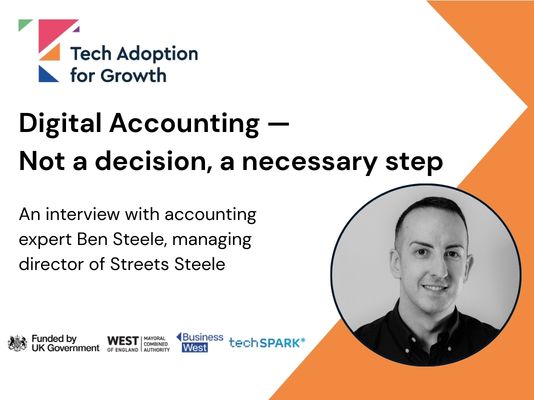

Digital Accounting — Not a decision, a necessary step

The transition from paper-based ledgers to digital and cloud accounting is a snowball picking up steam. While digital platforms are designed to streamline operations, the adoption often faces significant resistance, as many small business owners still view digital accounts as an unnecessary cost or struggle with a lack of understanding and awareness about the true benefits.
We recently sat down with Ben Steele, a finance expert who has witnessed the industry’s evolution over 17 years, transitioning from using "big giant books" to today’s digital cloud accounting. Now managing director of his own firm, Streets Steele, Ben is a strong proponent for digital accounting, having deliberately started his firm as fully digital. He now uses his expertise to guide businesses into the modern era of digital accounting.
Ben was happy to share his insights on how businesses can overcome initial barriers to adoption, and how to take full advantage of the technology to be more efficient.
Hi Ben, tell us a bit about you, your experience with digital accounting and how you came to be where you are now?
I’ll try to keep it short! I’ve been in accounting for just over 18 years. I joined at the time when everything was still pretty much paper based, and we had these large books we had to hand write data and calculations in. Since then, I've seen it right through the transition towards computerised accounting, and now to where we have AI technology and digital cloud accounting.
About 10 years ago before I started my own firm, I was working for other firms and seeing a real lack of excitement for tech in the industry. There was a disconnect between tech and how it could benefit business owners. When I decided to bite the bullet and start my own firm, I used it as an opportunity to start with a clean slate so from day one, it was fully digital, fully cloud, no paper.
We focused on pushing the benefits of efficiency and ease of use to business owners and my firm grew. Then about two years ago, I was approached by the Streets Group, a top 40 firm who said, "we've been watching you and we love what you've created” and here we are today, two years later, helping to move others towards digital accounting.
In your experience, what is the biggest barrier to getting started with digital accounting?
There are two big ones I come across daily, especially since Making Tax Digital (MTD) was announced earlier this year and due to go into effect in 2026.
The first one is cost. Small business owners still see digital accounts as an unnecessary cost. This feeling is just a lack of education and awareness of the reality that the benefits will always far outweigh the costs of a monthly subscription to something like Xero. That £20 a month is immediately made back by the time and efficiencies and improvements to your business. Naturally, to small business owners, everything's getting more costly and it's difficult when they've been running their business absolutely fine up until now. Why do they need this software?
The second biggest reason is just a lack of understanding as to what digital accounting is. A lot of small business owners have probably heard of it at least: Xero, QuickBooks, Sage, etcetera, but what is it? What can it do for your business? They need to understand you are not too small to be on something like this software. Once they've had proper education and guidance, they then understand, "Actually. Yeah. This is good for me, and I do need to be on that".
What are the main benefits for taking that financial leap to investing in digital accounting?
The biggest benefit is time that you get back. When you’re a small business owner, you're wearing every hat, running the actual operations of your business as well as marketing, finance, accounting, HR. Before you know it, you're doing 10-11 hour days, you're working weekends, you're not switching off on holidays.
When you get introduced to something like Xero, suddenly the admin side of running your business speeds up tenfold. Invoicing out, collecting money in, having automatic reminders going out, chasing debts for you, keeping track of debts, cash flow planning, all of it is made so much simpler.
Digital accounting helps answer the crucial question: "Are we even making a profit or am I just running a business like a busy fool?”
I could go on and on and on for hours about the benefits of it, and this isn't coming from somebody who works at software company like a sales pitch. This is coming from somebody who walked the walk themselves, and whose team are helping over 800 small businesses across the UK, so we live and breathe this, and we see and implement the benefits for people.
How easy is it for someone with low tech confidence to get to grips with technology like this?
Actually, these days it’s a lot easier than it used to be.
One option is for them to approach the software company themselves. They will give you live demos of the software, explain what it can do for your business, how to get set up and started.
The second option is work with an accountant who knows what this software is and can run demos and training. At Streets Steele we set up new businesses on it and can provide training sessions and get you set up.
If your accountant can't answer your questions on digital accounting tools, it's probably a good indication that it’s time to move accountants. If they aren't adopting cloud accounting in 2025, they're years and years behind.
But overall, for someone with low tech literacy, using the tools is easy. The hard part is the complex technical stuff up to that point, like making sure things are coded correctly or knowing what expenses can be claimed and how. If you're not educated and trained in bookkeeping and accounts, I would recommend you hire an accountant or a bookkeeper to do that bit for you.
You mentioned Make Tax Digital earlier. MTD doesn't impact all businesses right away, do you think it's a sign of where things are moving across the board?
100%. We saw this get implemented a few years ago with MTD for VAT. So, phase one has already been in place for several years now.
Phase two making tax digital for income tax starts in April 2026 and again it's a stepped approach. Stage one in April is for everybody earning over £50K. The year after, everybody over £30K and then pretty much everybody else later down the line.
We see this eventually being rolled out across all things tax. There's no fixed dates or time scales, but if MTD for income tax goes to plan, it won’t be long before pretty much everything is digitised. We're fast approaching the point where this won’t even be a decision, it’ll be necessary.
So, what advice could you offer to businesses to help them get ready to adopt this technology if they're not using it yet?
Step one is a mindset change. You need to sit yourself down and realise it doesn't matter what industry you’re in or what size you are. You can be the smallest self-employed freelancer up to the biggest limited company. Digital accounting is for every size, shape, and industry.
Step two is to check out the software available. There are three or four main players but check out as many as you can. Although we're big supporters of Xero, the best way to know which one is going to work best for you is to have a go. Get a free trial, have a click around. See what seems to be most intuitive to you and then book a demo.
Step three is then to start digitising the processes in your business. Whether it’s invoicing customers or making payments, start working through the different parts of your financials and start getting them onto that software. You’ll quickly find that within a couple of months it's working really smooth.
Are there any big pitfalls or common mistakes people make that they should watch out for?
Like I mentioned earlier, the tools are easy to use but the technical work that goes into getting them running is where mistakes get made.
Something we see a lot is people filing completely incorrect numbers simply because of how easy it is to do, but also because the tools will do nothing to stop you from doing it. You generally won’t realise you’ve made that mistake for months when someone comes knocking on your door with a load of penalties and fines.
It’s another reason why I recommend getting someone in to help you set everything up and train your team on how to use it correctly. It’s not scary and expensive but it will save you a lot of stress and potential problems later.
Digital accounting isn’t a shiny extra anymore, it’s the only way to run a business efficiently in 2026 and beyond.
Interested in finding out how digital accounting tools can save you time and effort?
Sign up now to the Tech Adoption for Growth pilot to access the practical guidance, tools and expert support to help you master the technology and skills that will work for your business, not against it.