
Q&A with Phil Smith: Reflecting on three decades of change

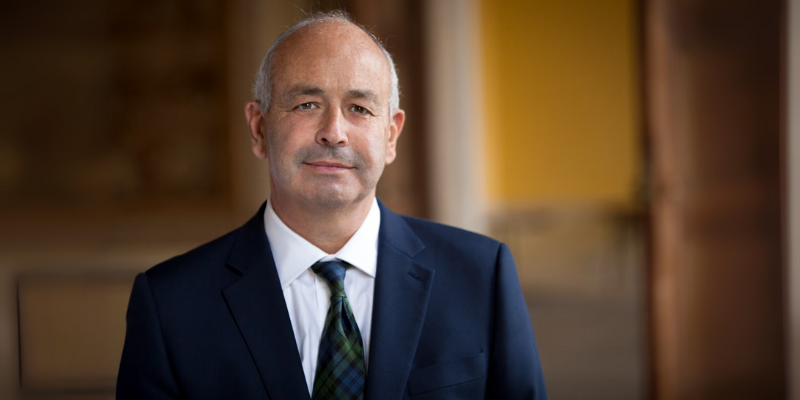
As our Managing Director, Phil Smith, steps down after more than thirty years at Business West, we sat down to talk about the organisation he helped shape, the journey that brought him here, and the lessons learned along the way.
Do you remember your first day here?
I remember it very clearly. Business West was based in Clifton Park, in the old Bristol Chamber of Commerce building. Behind reception there was a room packed with maybe thirteen or fourteen women who ran the Chamber’s information desk, led by an incredible manager called Sarah Harris.
If you wanted to know the exchange rate for the Portuguese escudo, or the price of fish somewhere, or any obscure fact, you phoned Sarah’s team. There was no Google, no internet, just rows of filing cabinets, directories and reference books.
That entire service has now been replaced by the internet, and by tools like ChatGPT, but that first impression has stayed with me and I remember it fondly.
What path led you to Business West, and what was your first role?
I came in as Chief Executive of Business Link West, which was a government and Chamber of Commerce joint venture. I was 32, quite young for a Chief Executive, and it was my first time in that kind of role. My background was engineering and finance, so I could handle numbers and structure, but public–private leadership was new.
I started my career in the 80s as an oil field engineer, working in the North Sea. It was a little like the Wild West at that time. It was also very international, with Vietnam veterans as helicopter pilots and marine and diving crews from around the world.
I had to coordinate a team of divers, whether they were laying a pipeline or repairing a leg on an oil rig platform. It was my job to ensure they worked effectively together as one team. It was well-paid, but unsustainable long-term. Then oil prices crashed to around $10 a barrel in the late ’80s, and the work dried up.
I then decided to do an MBA at London Business School. I really enjoyed being around super-international, super-bright, and super-ambitious classmates. It also opened up a path into corporate finance.
I then became an executive in the City and leveraged my experience in managing teams. However, the bank I joined became caught up in the Blue Arrow scandal and restructured heavily. My job disappeared. At the same time, our 3% staff mortgage shot up to around 14% because of interest rate hikes. My wife had just had a baby, and we needed to move.
We decided to head West and ended up in Bristol. I applied for the Business Link role, interviewed, and got it. And that turned into the start of a thirty-year journey.
Did you imagine you’d still be here three decades later?
No, not at all. But Business West has constantly evolved, which has kept life interesting. Our geographical footprint has grown, we’ve taken on new national programmes, entered new sectors, reshaped services, diversified funding. Every year felt different.
Some days I find myself talking about aerospace innovations; other days, discussing skills, policy, global trade or infrastructure. The variety and pace has kept me here far longer than I ever expected.
I like the hinterland between public and private sector. I think I would get frustrated working purely in the public sector. We are entirely owned and controlled by our business members. I like the fact that Business West is a private company doing public good.
What do you consider your greatest achievement during your time here?
Helping shape Business West into a purposeful and respected organisation. We are genuinely focused on driving prosperity for businesses and our region.
We help individual businesses succeed, we convene and build evidence to help influence change.
I’m proud of the culture too. We employ 170 people and it is a good place to work. Building that environment, together, is something I’m deeply proud of.
What were the biggest challenges of the role?
Without question, operating in the volatility of government contracts. A significant proportion of our income comes from competitive bids. Those programmes can be altered, retendered or cancelled very suddenly.
When that happens, you face redundancies or TUPE transfers. It’s difficult for those directly affected, but also unsettling for those who remain. You can spend years building a strong team only to have it disrupted by a decision entirely outside your control.
Managing that uncertainty, while protecting staff and maintaining organisational stability, has always been one of the toughest responsibilities.
Who has had the greatest influence on your career?
Several people. Business West’s Chair, Colin Skellett, taught me the importance of responsiveness. If you contact Colin, whether by phone, email, text, he gets back to you. Quickly. It shows respect and decisiveness. I’ve always tried to follow that principle.
My parents were also very influential. They were both teachers, quietly encouraging and committed to learning. They instilled values of curiosity and effort in myself and my sisters, without ever being overbearing.
And then there’s John Savage, former Bristol Initiative Chief Executive. When I thought I was thinking long-term, he was thinking a decade beyond that. He shaped my understanding of organisational purpose.
What lessons have you learned about leadership?
Authenticity is vital. When you lead with consistency and genuineness, people know where they stand and can place their trust in you. I think the Mayor of the West of England, Helen Godwin, has this and it helps a lot.
A crucial part of that authenticity is emotional intelligence. Leadership isn’t just about how you see the world; it’s about how others experience your decisions. It’s the ability to recognise emotions and understand the perspectives of staff, partners, and customers enables leaders to connect, communicate, and make sound, empathetic choices.
Empathy can sometimes cause you to worry too much about what other people may be thinking and doing and result in you not being decisive enough. So, there is a fine balance to find between being empathetic and yet bold enough to make decisions that may upset some people.
Clarity of purpose is equally important. Organisations drift when they lose sight of why they exist, and people want their work to contribute to something meaningful. When leaders articulate a clear mission, they give others a reason to care and a direction to move in.
At Business West, our three pillars; the Chamber, business services and policy work, all reinforce each other. Each makes the others stronger.
Finally, decisiveness matters. Most people prefer a clear “yes” or “no” over prolonged hesitation. Timely decisions reduce uncertainty, build momentum, and signal confidence, even when those choices are difficult.
Where do you see the greatest opportunities ahead, for Business West and the wider region?
This region has been reinventing itself for decades. When I arrived in Bristol, traditional industries like tobacco and printing were waning; now the dominant industries are advanced engineering, technology, creative sectors, and finance.
Looking forward, I think the big opportunities are around: AI and digital innovation, low-carbon energy, advanced manufacturing and aerospace, research commercialisation, skills and workforce development.
Opportunities vary by sector, so Business West focuses on where the economic potential is and not on political boundaries.
Aerospace and advanced manufacturing are huge strengths but not guaranteed. If we’re complacent, local companies may decide that future production belongs elsewhere. Part of our work must be to actively protect and develop these strategically important industries. Not just for our region, but the UK too.
Closer to home, we also have a major asset to consider: Leigh Court. Post-COVID, our workforce is spread widely across the region and uses the building very differently. Selling it would allow us to reinvest in services for our members and customers and regional development initiatives.
And then there’s Futures West, which Business West initiated and is a collaboration between businesses and leading universities to drive long-term change for the benefit of the Wider West of England Region. It was our Director of Policy, Matt Griffith’s, brainchild and is now championed by Sir Iain Gray and Andrea Dell.
Thinking in decades rather than political cycles will be vital. Futures West and Business West have an important part to play in planning the region’s future. If we do not plan and work towards it, it will just roll over us.
What will you miss most?
I’ve really enjoyed seeing progress. I like seeing things move forward; people, services, strategies, industries. Business West is a place where change is constant, and momentum is normal.
I’ll miss the people too of course. I’ve been involved in recruiting everyone here, apart from just two colleagues who pre-date me. That’s a big family to miss.
What advice would you give someone starting their career?
Don’t hold yourself back. Careers are more flexible than people think. Aim high, stay curious and work hard.
Develop emotional intelligence. Try to understand what your manager, colleagues or customers need from you. It’s remarkable how far that mindset can take you.
Don’t be too arrogant or cocky. When I was 18, I had done very well at my local state school, I had captained the rugby team, been head boy and got straight As at O Level. I assumed A-levels would be easy. I barely worked and missed out on a place at Cambridge. So, that was a hard but valuable lesson.
What gives you confidence about the region’s future?
The people. Through my work with City of Bristol College and other partners across the region, I meet young people preparing to enter all kinds of industries; engineering, hospitality, technology, construction, creative sectors, health, social care. They are the lifeblood of the future economy.
And I’ve always appreciated that Business West sits between heritage and innovation. We’re rooted in more than 200 years of business community, but also deeply connected to the region’s most forward-looking companies, innovators in AI, green technology, advanced manufacturing and digital transformation. We’ve survived this long because we’ve been able to adapt to, and support, change.
Finally, what does life after Business West look like?
I’ll spend more time with my granddaughter, but I’ll continue doing work that matters to me, especially around skills and education. That’s why I’ve taken on the Chair of City of Bristol College.
I feel very fortunate. Many people start looking for meaningful roles when they retire; I’ve been able to do that sort of work throughout my career.
What I feel most of all is gratitude. This job has opened doors I never expected, introduced me to people I deeply respect, and allowed me to play a small part in shaping a region I care about. It has been a privilege.