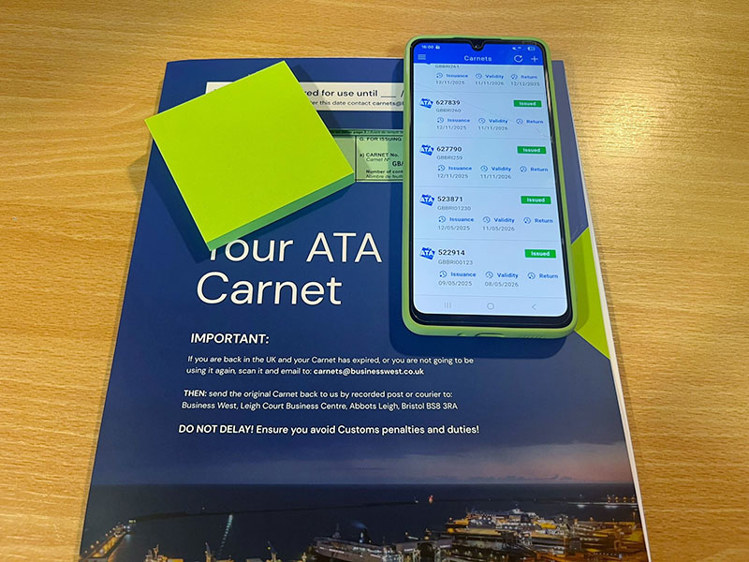
Taking professional equipment, exhibition goods or commercial samples overseas? An ATA Carnet acts as a passport for your goods, allowing you to take eligible items abroad temporarily without paying import duties and taxes, provided you meet the relevant conditions. It can make customs clearance simpler, but missing equipment details, an unexpected change of route or a missed customs stamp or scan can still cause problems.
Our Carnet team shares some common mistakes — and the checks that can help you avoid them.
Your Carnet is ready, but are you ready?
Your equipment is packed, transport is booked and your ATA Carnet is ready. But have you checked where customs will process it – and whether your whole journey is covered?
Problems can arise when details are missed when you apply or customs procedures are overlooked along the way.
Our Carnet team helps businesses work through these issues. Here are some of the mistakes they encounter, and what you can do to avoid them.
An incomplete general (equipment) list can cause problems before you leave
The general list is the record of the goods covered by your Carnet. Customs uses it to identify what you are taking overseas, so descriptions need to be clear and specific.
Include enough information for customs to identify each item you are taking, including the make, model, a detailed description of what the item is and its serial number (for electrical items).
Check that every item you intend to move under the Carnet is included, and provide the required weight and value information. Don’t assume that smaller items or accessories can simply travel under the description of the main piece of equipment and remember not to include anything that will not be returning to the UK.
Before applying: Compare your equipment inventory with your general list, rather than relying on memory.
Goods omitted from an issued Carnet may need a separate Carnet; HMRC also warns against changing goods descriptions after issue.
Plan the whole route – including countries you pass through
Your final destination is only part of the picture. Tell us about the full itinerary, including countries or customs territories you will (or potentially will) pass through on the way there and back.
For example, if you are travelling through the EU to reach Switzerland, the EU needs to be included as well as Switzerland.
Overseas Territories have to be listed individually on the destinations list and are not included when choosing the 'parent' country, e.g Canary Islands must be listed separately, or in addition to, the European Union.
Also consider how many visits you expect to make. Adding extra visits after your Carnet has been issued incurs a fee, so thinking ahead can save additional administration and cost.
Make sure customs records your goods entering and leaving each relevant country or customs territory. If your return route changes, speak to our team to check whether your Carnet and security cover the revised journey. Entering the EU through one member state and leaving through another is permitted, but both movements still need to be recorded correctly.
A 12-month Carnet does not mean a 12-month bond (security)
Your Carnet’s validity and the duration of your bond (or Carnet security) are separate things.
Business West offers bond periods of two, six or twelve months. If you choose a two-month bond, you should not assume you can continue travelling under it for the full twelve-month validity of your Carnet.
Your security arrangements also need to cover the countries you visit. Travelling to a country outside that coverage, or after the agreed bond period, can create problems.
Find customs before you travel
Knowing which port or airport you are using is not enough. You also need to know where your Carnet will be processed.
Check the location of the appropriate customs office, its opening hours and whether any advance arrangements are required. Allow time in your schedule to present both your goods and your Carnet.
A customs office may be away from your expected departure point. Finding this out when you are already running late can leave you with a difficult choice – and travelling without the required customs processing can create problems later.
Before travelling: Give the person carrying the goods clear instructions for each customs stop, including the return to the UK.
Check the deadline Customs gives you
Your Carnet’s expiry date is not the only deadline to watch. Customs may set an earlier date for taking goods out of a country or completing a transit movement. Check any deadlines recorded by customs and plan your journey around them. Missing a deadline can lead to a claim, even if the goods are eventually brought home.
Digital Carnets still need customs processing at each stage of your trip
Check validation and exportation
When first leaving the UK with your Digital Carnet, make sure UK customs completes both the initial validation and the exportation transaction. They are separate steps: completing one does not replace the other.
Throughout your journey, present the relevant QR code for each required customs movement. Missing a scan can leave a gap in the record of where your goods have been.
Check which goods you are declaring
Take time to review your declaration before presenting it to customs, particularly on the return journey.
Our team has seen cases where users accidentally declared that goods were being left abroad when they were actually bringing them home. An incorrect declaration can prevent us from closing the Carnet until the issue is resolved.
Check the selected item numbers and read each option carefully. If the declaration does not reflect what is happening to your goods, seek help before it is processed.
Use the app and check the transaction record
Our team recommends using the ATA Carnet app rather than relying only on screenshots of QR codes (which customs will not accept). The app allows you to check the transaction record and see whether customs has completed the required processing.
If someone else is travelling with your goods, share the travel code so they can add it to their app or device wallet.
Synchronise the app regularly and check that the expected transactions appear.
Bringing the goods home is not the final step
Getting your equipment back to your premises does not, on its own, complete the Carnet process. Your return to the UK must also be recorded by customs through the appropriate stamp or digital transaction.
If you discover that this has been missed, contact our Carnet team promptly. You may need a Certificate of Location to provide evidence that the goods are back in the UK.
Don’t put the Carnet aside and assume the issue will resolve itself. Acting early gives you the opportunity to obtain the evidence needed.
Check that you can account for every item taken overseas. If goods return in separate shipments, each movement must identify the items involved and follow the relevant customs requirements. If anything will remain abroad, contact our team before leaving it there. Goods that have not been properly accounted for can result in a customs claim.
And don’t forget to tell us when you have finished using your Carnet. We can then carry out the discharge process.
Carnet checklist:
Before each trip, check: