Swindon Mindful Employer Network - September 2026
Welcoming mindful employers to join us for discussions around the topic of women's mental health and menopause in the workplace.
Wed, 02 September 2026
09:30 GMT
The latest Swindon Mindful Employer Network event brought employers together to explore loneliness and isolation in today’s workplaces.

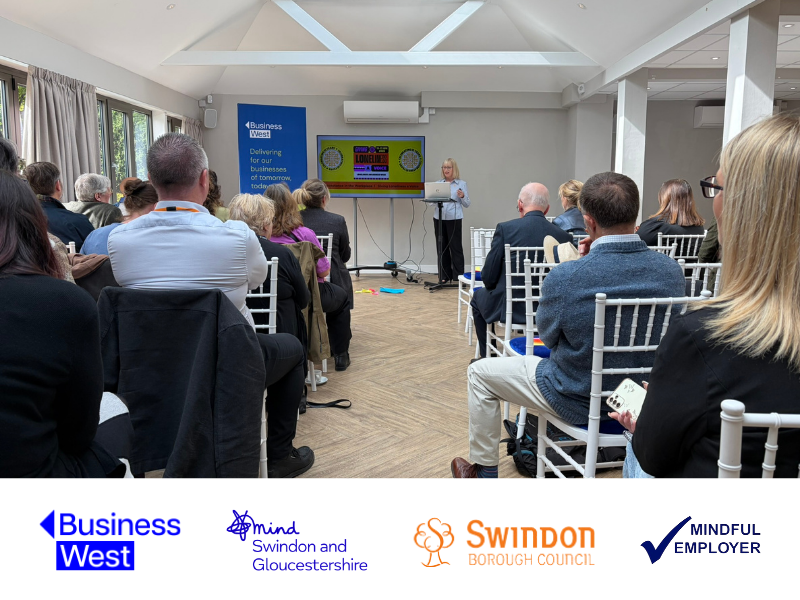
Earlier this week, we were pleased to welcome attendees to the second Swindon Mindful Employer Network event of the year - a collaboration between Business West, Swindon Borough Council and Swindon and Gloucestershire Mind.
Ahead of Mental Health Awareness week in May and Loneliness Awareness Week in June, the event explored practical steps organisations can take to spot loneliness patterns, reduce stigma and build connections at work.
The session opened with a simple but thought-provoking exercise led by Lynette Buebird from Swindon and Gloucestershire Mind, using a loneliness scale to prompt honest reflection. Participants placed coloured Post-it notes on the scale to represent how often they experienced loneliness in both their work and personal lives.
It quickly became clear that loneliness at work is not always easy to spot. It can appear in everyday situations, such as feeling overlooked in meetings or struggling to find your place within a team. For some, it is linked to particular life stages or experiences.
Lynette highlighted groups who may be particularly vulnerable to workplace isolation, including:
• Parents balancing competing responsibilities
• Neurodivergent employees who may find communication or collaboration more challenging
• Individuals from minority groups or with disabilities
• New starters navigating unfamiliar environments
• Employees returning from leave, such as sickness or maternity leave
These insights set the tone for the session: loneliness is complex, human, and more common than we might think.
The group explored what underpins a sense of connection at work. Self-determination theory was introduced as a useful way of understanding this, as it identifies three core psychological needs that underpin wellbeing and connection at work:
• Autonomy – having a sense of control
• Competence – feeling capable and effective
• Relatedness – feeling connected to others
When these needs are not met, it can have a noticeable impact on energy, motivation and engagement. This led to a wider conversation about resilience and how people respond to pressure.
Lynette reflected on common behavioural patterns through the “drama triangle” (victim, persecutor, and rescuer roles) and how these can impact workplace dynamics and personal resilience. These responses are familiar in many workplaces and can affect both individuals and teams over time.
One of the strongest themes from the session was the importance of small, everyday moments. Simple interactions, such as asking a colleague how they are and taking the time to listen, can have a meaningful impact.
In hybrid and remote working environments, these moments are less likely to happen naturally. Many organisations have seen a reduction in informal conversations and unplanned interactions, sometimes known as “water-cooler moments”, which were once a key part of working life.
As a result, connection often needs more thought. Checking in with colleagues after time away, making space for informal conversation, and showing interest in how people are feeling can all help to strengthen relationships.
Tara Fisher from Marmalade Trust shared insights into the scale of loneliness and its impact on both individuals and organisations. As the organisation behind Loneliness Awareness Week, Marmalade Trust works to raise awareness and reduce stigma.
A key message from the session was that loneliness is a normal human experience, but one that many people still find difficult to talk about.
Tara introduced a simple three-step framework for employers:
• Acknowledge – normalise conversations around loneliness
• Identify – recognise patterns and areas where connection may be lacking
• Act – take practical steps to strengthen relationships
There is also a strong business case for addressing this. Loneliness is linked to reduced productivity, increased sickness absence and higher staff turnover, all of which have a direct impact on organisations and can cost UK employers up to £2.5 billion per year.
The session highlighted a number of simple, low-cost actions that can help build connection in the workplace and organisations can implement straight away:
• “Walk and talk” meetings to encourage informal conversation
• “Body doubling” - shared virtual working sessions that create a sense of presence
• Short “check-outs” at the end of meetings to ensure all voices are heard
• Greeting colleagues by name and asking open, everyday questions
The focus was not on introducing complex initiatives, but on being more intentional with existing time and interactions. These small actions, repeated consistently, can have a powerful cumulative effect.
Connection doesn’t need more time, it needs more intention.
The Q&A session gave attendees the opportunity to explore some of the challenges they are facing in their own organisations.
One discussion focused on how to engage leaders who may not naturally prioritise relationship-building. Sharing evidence and highlighting the organisational impact of loneliness can help to build understanding and support.
There were also conversations around hybrid working. While many organisations encourage time in the office, some employees prefer to work from home full-time. This raised questions about how to create opportunities for meaningful connection, while also recognising that different people work best in different environments.
The session closed with a chance for attendees to reflect on their own workplaces. Where does connection feel strong, and where might there be gaps? What small changes could be introduced to better support employees?
The overall message was clear. Connection at work does not happen by chance; it requires intention, but it does not need to be complicated.
The next session in this series on 2nd September will focus on women’s mental health in the workplace, including a focus on menopause and post-partum depression.