
From pathways to productivity: skills insights from the Bristol Initiative Winter Members’ Evening

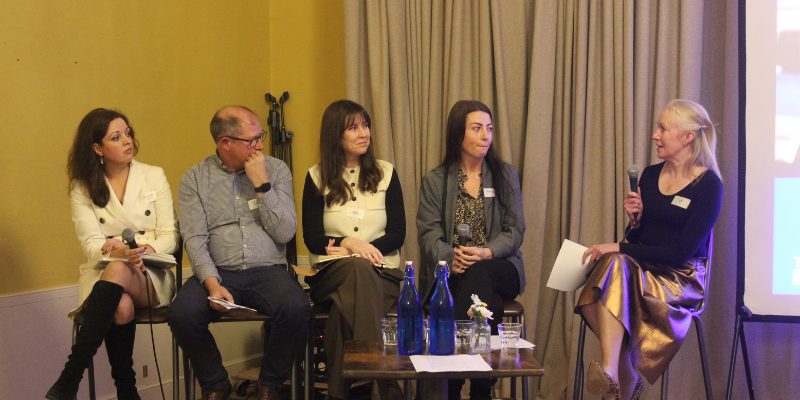
The Bristol Old Vic provided an evocative backdrop for December’s Bristol Initiative Members’ Evening. Members gathered in the historic Bristol landmark, first opened in 1766, to explore how the region can build a skills system capable of meeting its economic ambitions for the decade ahead.
The centrepiece of the evening was a panel discussion chaired by Dr Jo Dally, Chief Business Officer of NCC, Mayor’s Business Advisor and Interim Co-chair of the Business Board for the West of England Combined Mayoral Authority, which focused on what a successful skills system must look like if the region is to deliver the 72,000 new jobs envisioned in the West of England Growth Strategy.
The discussion made one thing clear early on: skills are no longer simply an educational concern, they are regional infrastructure.
Clarity of pathways: learning that reflects real lives
The first challenge raised by the panel was the need for clarity. Julia Gray, Principal and CEO of City of Bristol College, highlighted that a successful skills system must be easy for people to navigate at every stage of life. Ambitions change, circumstances shift, and young people need to understand their options long before the age of 16. Her view positioned lifelong learning not as a policy aspiration, but as a practical necessity. A system that allows people to move smoothly between roles, industries and levels of expertise is one that enables businesses to respond quickly to emerging opportunities.
Agility as a strategic advantage
Where clarity provides the foundation, agility gives the region’s competitive edge. Steph Parsons, Vice President – People, Defence at Rolls-Royce, emphasised the sheer pace at which roles are evolving, driven by technology and global market pressures. The defining capabilities of the next decade may be adaptability, attitude and the capacity to learn at speed. By hiring for these core capabilities, businesses can withstand technological disruption and pivot as market conditions demand. Steph’s contribution underscored that agility is not just an individual trait, but also a system-level requirement. The region needs training that can keep pace with changing roles and emerging technologies.
Valuing human skills as drivers of inclusion and growth
Dr Zara Nanu MBE, Founder of WorkVue and Professor in Practice at University of Bristol Business School, brought a sharp focus to the economic importance of human skills. She warned that the UK continues to undervalue work requiring empathy, care and interpersonal capability, roles disproportionately undertaken by women. Without intervention, she argued, many women risk being locked into low-paid sectors by 2030, even as their skills become more important in an AI-enabled economy. Zara reframed human skills as essential economic assets that complement technology rather than compete with it. Recognising their value would expand the region’s labour supply, support more inclusive growth, and ensure that the benefits of innovation are widely felt.
Business as co-designer of skills, not just consumer of talent
Turning to the role of employers, Alex Richards, Managing Director at Western Training Provider Network, urged businesses to treat learning as a long-term strategic investment. Rather than viewing training as a cost, he positioned it as a core component of competitiveness. His perspective challenged businesses to engage earlier with young people, to shape content in schools and colleges, and to think differently about developing their own teams.
One of the practical insights Alex shared was the growing integration of AI modules into apprenticeship routes, making upskilling accessible to both younger learners and existing staff. He also stressed the potential of peer-to-peer models, where young employees support new entrants, building confidence and work-readiness from within. His approach reframed employers, not as passive recipients of talent, but as active builders of capability.
Addressing the NEET challenge through earlier and consistent engagement
An important part of the discussion centred on the rise of young people not in education, employment or training (NEETs), an issue now at its highest levels in a decade across the region. The panel stressed that the roots of this challenge extend back well before GCSE age. Young people need to experience the world of work repeatedly and meaningfully, not through single touchpoint encounters. Many continue to feel the effects of lockdown: disrupted confidence, reduced engagement and heightened anxiety.
The panel argued for a more coordinated regional approach to mentoring, one that makes it easy for small and large employers alike to participate. Parents and carers must also be better integrated into this work, given the crucial influence they hold over career decisions. When one audience member commented “imagine if everyone in this room mentored someone,” the sentiment captured a broader truth: mentoring is not an act of charity, but a strategic investment in the region’s future workforce.
AI: augmenting people and ensuring no one is left behind
Artificial intelligence was another thread. The panel agreed that AI should be used to remove administrative burden and unlock higher-value work, but they also stressed the importance of remaining vigilant to risks such as over-reliance, embedded bias, and the potential erosion of critical thinking.
A particular concern was the risk that SMEs could be left behind without accessible and affordable routes to upskilling. The region’s ability to convert technological progress into productivity gains will depend on ensuring businesses of all sizes can adapt. On this theme, Steph reinforced the need to design roles with future change in mind. Businesses may feel confident about the next two years, she remarked, but they must retain the flexibility to pivot beyond that horizon. Her message echoed a broader point: the most future-proof skill will be the ability to learn continuously.
Leadership transitions and the region’s purpose
The evening also marked a moment of transition for the Bristol Initiative, as Phil Smith, Business West’s Managing Director, spoke at his final Initiative Members’ Evening after three decades with Business West. Reflecting on a career that has spanned recessions, political shifts, and technological revolutions, Phil highlighted the enduring pillars of the organisation’s work: supporting individual businesses, convening the regional business community, and building the evidence required to influence meaningful change. Phil also introduced our new CEO, Douglas Ure, who will begin his role in January. Phil remains in post until spring.
Where we go next
If one theme united the evening, it was that skills will determine the pace and inclusivity of the West of England’s growth. The region needs pathways that are clear, flexible and genuinely navigable; training systems that adapt as fast as technology; genuine recognition of human skills; and a coordinated approach to mentoring that supports young people long before they enter the labour market. It also needs employers who view themselves as co-creators of talent, working hand-in-hand with providers to shape the capabilities the economy will need next.
The Bristol Initiative will continue to collaborate with our third-sector members who champion opportunities for the next generation. Through organisations such as Ablaze, Babbasa, My Future My Choice and Learning Partnership West, and Business West’s work on the Local Skills Improvement Plans linking employers with educators, we are helping to build a skills ecosystem that reflects the needs and aspirations of our region.
Any members interested in engaging with these projects, either to share their skills or highlight their business’s own needs, should get in touch as we would be delighted to connect you.
These themes will continue to shape our work into 2026. We look forward to seeing our members at the Spring Members’ Evening on 4 March 2026 at Bristol Beacon, where we will hear an exclusive early insight into the forthcoming regional Economic Audit from Futures West and the Brunel Centre.