
Shaping the future of B&NES: insights from the B&NES Summer Members’ Event

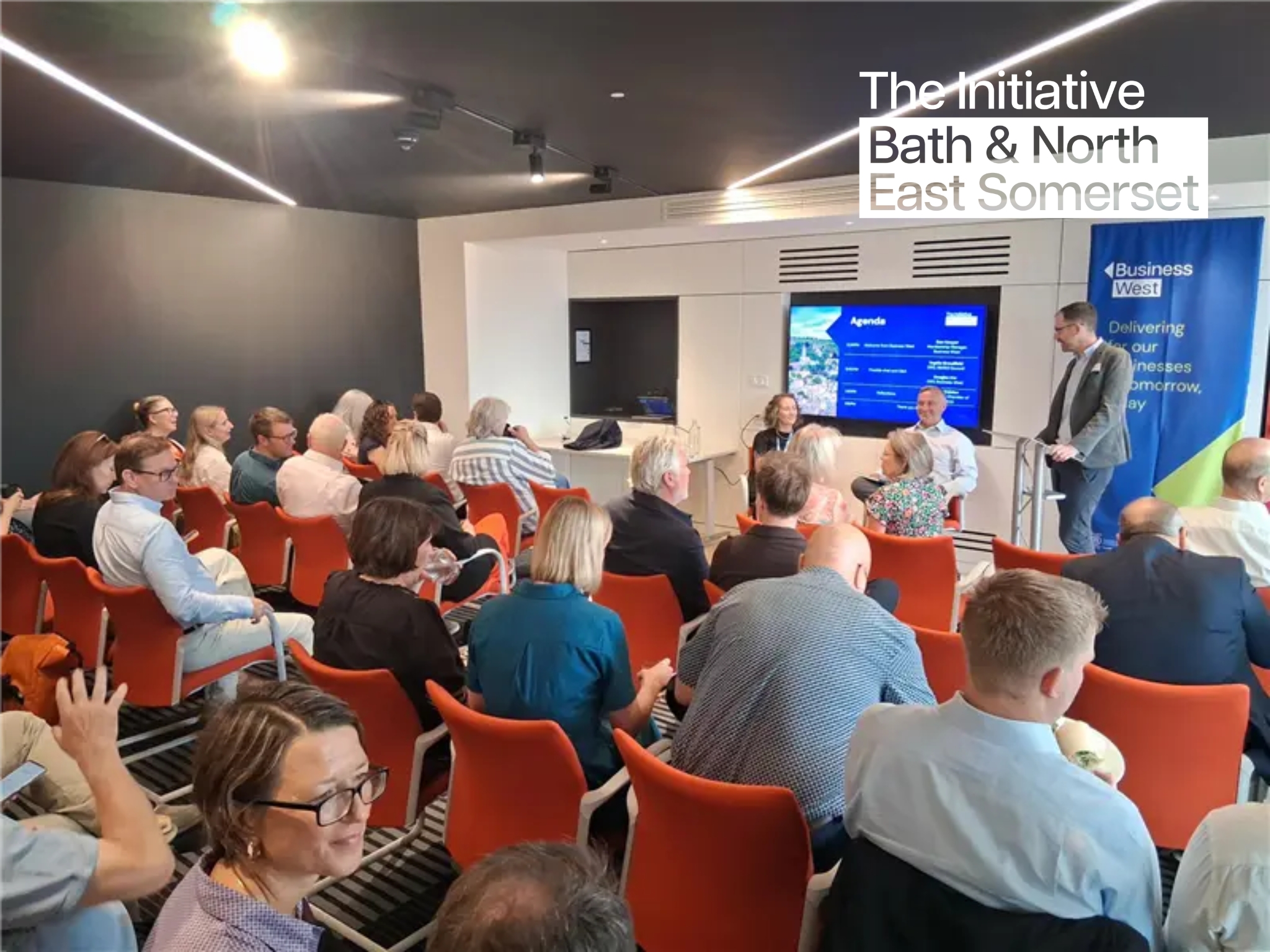
Members of the Bath & North East Somerset Initiative gathered last week in the heart of Bath for our Quarterly Members’ Event. On a bright summer afternoon, the region’s business leaders and changemakers came together for an opportunity to connect, as well as to enjoy the privilege of a fireside chat between Sophie Broadfield, CEO of B&NES Council, and our own Douglas Ure, CEO of Business West.
Having previously led the devolution of power to combined authorities at the Treasury, including the creation of the West of England Combined Authority (WECA), members were excited for Sophie to share her unique perspective on the interplay between central and local government.
In her conversation with Douglas, Sophie provided a frank look at the challenges facing the council and the region at large while also championing the collaborative spirit of the local community that offers a roadmap for a flourishing future.
Balancing budgets
Sophie opened with a transparent look at the strain of balancing the books in the current economic climate, noting that 80-90% of the council’s budget is dedicated to children’s and adult social care.
While this creates a strain on the budget, Sophie highlighted B&NES’s unique position compared to other authorities; it owns the Roman Baths, the only visitor attraction of its scale in the country that is truly profitable for a council, alongside a significant portfolio of commercial real estate.
However, no amount of supplementary income can cover the full cost. When Douglas asked about the trade-offs necessitated by these budget constraints, Sophie spoke candidly about her regret over the loss of early intervention services.
Over the years, the council has had to cut children's centres and play provisions to fund the statutory, "crisis-end" requirements of care. Eager to tackle this, Sophie is championing a shift towards prevention by working more closely with the voluntary and community sector to reintroduce services designed to support the public before the point of crisis.
Reimagining the B&NES economy
While Bath is globally recognised for its high street and heritage assets, the discussion highlighted a growing ambition to diversify the local economy and create more opportunities throughout the region.
Sophie acknowledged that while the retail, hospitality, and tourism sectors are the successful "base" of the city, more is needed to create a region that works for everyone.
However, the path to growth is unique in B&NES due to the physical and conservative constraints of being a World Heritage site. With limited land for expansion, the council is prioritising innovative ways to maximise existing urban space.
She pointed to the work being done to attract and scale professional services, engineering firms, and creative businesses that offer high-wage jobs and a greater diversity of career paths.
One such project is Broad Street Yards, a new development that will support creative and entrepreneurial uses across workspace opportunities and small, high-density retail units.
B&NES needs business leaders
If Sophie made one thing clear over the course of the discussion, it’s that the council cannot achieve their goals in isolation. When asked by Douglas how the private sector can best support this vision, Sophie’s ask was clear.
She urged leaders to act as vocal advocates for investment and change, noting that the business voice is often missing in public debates where it is much needed.
Beyond advocacy, Sophie challenged businesses to engage with “Good Work” by supporting apprenticeships, investing in progression routes and providing high-quality employment that helps people build stable, fulfilling careers in the region.
Providing good work, looking after employees, and helping people succeed, all mean less cost to the NHS, to councils and to the police.
Sophie’s message was one of partnership. She encouraged members to see the council as a collaborator rather than a barrier, inviting members to "pick up the phone" to discuss challenges directly with decision-makers.
In conversation with our members
The day concluded with a wide-ranging Q&A, where members posed the most pressing questions facing B&NES on how it can grow evolve without losing what makes the region unique.
Sophie met these challenges head-on. When asked if Bath’s world heritage status was a help or a hindrance, she argued that she would see the council move away from passive designation to collaborate more closely with UNESCO on a vision of Bath that doesn’t mean being “set in aspic”.
Another member asked how the council would balance growth without pushing out residents, students and young families due to rising housing costs, a concern felt keenly around the country.
While the council can’t perfectly organise a free market, Sophie acknowledged that more intervention is required when it comes to social housing and encouraging programmes that will help the local community share in the region’s prosperity.
Looking ahead for B&NES Initiative
The success of these events is driven by the commitment of our members to engage in the difficult, interesting discussions that look toward the future. We encourage you to keep a close eye on your inbox for invitations to our upcoming sessions.
If you’re not a member but would like to find out more about the B&NES Initiative, then get in touch with Dan Hooper, B&NES Initiative Membership Manager.