My journey started at Wembley on Saturday 11th July, where My Chemical Romance had just finished their show. For thousands of fans, the night was over. For the Stagetruck team, it was only just beginning.
I’d joined a fleet of around 20 trucks that were preparing to move the production from Wembley to Florence for the next leg of the tour, and I quickly realised just how enormous an operation this was.
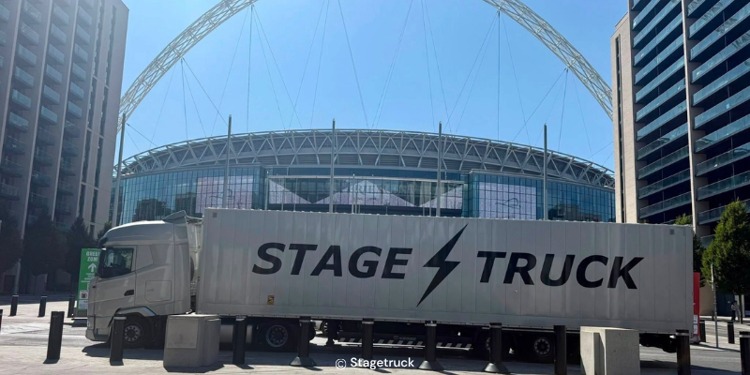
The trucks drove directly into the stadium once the audience had left so the equipment could be dismantled and loaded. The truck I travelled in was carrying only the right-hand side of the stage speakers and amps – another truck had the left-hand side – which gives you some idea of the scale involved.
The convoy eventually left Wembley at around 2.30am on Sunday morning and headed straight for Dover. By then, I’d already had a slightly unexpected start to the trip as I’d ended up helping with some complicated USA issued Carnets backstage.
It was an early indication that on tour, what you expect to happen and what actually happens can be two very different things.
Carnets in action
At Dover, we used Motis Freight Clearance Centre to process the Carnets on the UK side. The experience was efficient and straightforward. The paperwork was processed in around 30 minutes, which meant much of the convoy was able to catch an earlier ferry than originally planned.
The Stagetruck drivers were incredibly experienced and had done a huge amount of preparation in advance. Lee, the lead driver, had written detailed notes within the Carnets linking them to GMRs and Digital Carnet information, helping customs teams understand which goods and vehicles related to which documents.
But not all of the trucks were able to travel together. Some of the drivers had to follow a different process for their ferry bookings, so Lee stayed behind with them – taking all of the Carnets with him. Once the first group reached Calais, we had to wait for the rest to catch up.
Ferry image
Then came French customs.
The checks were much more thorough and took significantly longer. Digital Carnets were checked alongside paper back-ups and other supporting documentation, and the process took around an hour and a half once the full convoy was together.
That delay immediately put more pressure on the schedule. And that was one of the first things that really struck me: when you’re moving a major touring production hundreds of miles to the next venue, a customs delay isn’t just an inconvenience. Every minute matters.
Life on the road
After Calais, we headed further into France. I very quickly learned that touring logistics has its own rhythm.
Drivers work around strict legally mandated rest periods, often travelling through the night and sleeping during the day. At one point I slept from around 11am until 8pm, which felt completely bizarre at first, but by then normal body-clock rules had pretty much gone out of the window.
I also discovered that Sublime Radio NL is a very good soundtrack for overnight driving, and I came away with the impression that touring driver life relies on a fairly formidable combination of coffee, cigarettes, patience and a lot of waiting around.
One truck in the convoy even had its own nickname. Dave was driving an older white vehicle affectionately known as “the washing machine”, and as we headed towards the Alps there was genuine discussion about how well it was going to cope with the climb.
Through the Alps and into Italy
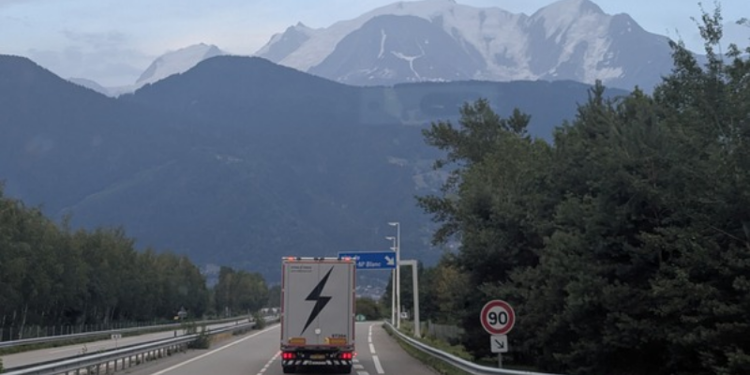
On Monday evening, we left our rest stop near Cluses and headed towards the Mont Blanc tunnel. This was probably one of the most memorable parts of the journey. The Alpine scenery was incredible. I knew mountains were big, obviously, but seeing them from the cab of a heavily loaded truck gave me a whole new appreciation of the scale of them.
Getting a fleet of touring trucks through the mountains was not without its challenges, though. There was concern about whether some vehicles – particularly “the washing machine” – would manage the steep climb, but everyone made it through and we crossed into Italy at around 9.16pm.
From there, the plan was to continue towards Florence. Simple enough. In theory.
We were supposed to head towards Milan, Bologna and then Florence, but road closures forced us towards Genoa instead.
Then, once we got to Genoa, more roads were closed. We spent around two hours trying to find a workable route out of the city before eventually getting back on course.
By this stage, the touring schedule had become even tighter.
The original plan had been to reach Florence on Wednesday morning, but production had changed the timetable and brought the deadline forward, asking the trucks to arrive by 6am on Tuesday instead. So every delay mattered.
Arrival in Florence
After driving through the night, we finally reached Florence on Tuesday morning. We arrived at the Visarno Hippodrome at around 8.30am after a journey that had included customs checks, ferry crossings, overnight driving, daytime sleeping, mountain roads, road closures and several last-minute changes.
Ironically, despite all the urgency to get there, the trucks that had arrived earlier were still waiting to unload. That was another useful reminder that international touring involves a huge number of moving parts – and the Carnet is only one of them.
FAITH VIDEO