
Q&A: How can your small business start using and benefitting from AI?

Mark Williams Business West
02 July 2026

AI expert Alex Bacon of Bath-based consultancy BrightKeel.AI shares his insight on how sole traders and other small businesses can maximise their benefits from using AI 

What did you do before starting Brightkeel.AI in 2025? 

“I spent most of my career in marketing roles in IT services. I worked for a couple of MSPs [managed-service providers] which managed various IT services for its clients, before helping to launch an online law firm. More recently, I was marketing director of Microsoft Partner Cloud Direct, helping grow its turnover from £4m to £38m. That brought me into the fascinating world of AI.”

Please tell us about BrightKeel.AI... 

“We help small businesses make sense of AI, so they can better implement AI and gain from it. AI is a people- and change-management challenge, it’s not purely technical. We mostly help businesses that don't have an AI strategy or don't know how to map it to their needs. We take them on that journey, offering tiered services. For micro businesses, which could be a one-day AI strategy workshop, helping them to find where and how they should be using AI.”

You must take a structured approach to introducing and using AI. You need an AI strategy that’s guided by your specific business aims.

Are more small businesses now using AI?

“Many more small businesses are using AI, but not necessarily in a considered, controlled or consistent way. Some small businesses are way ahead of others, but however big your business is, you must take a structured approach to introducing and using AI. You need an AI strategy that’s guided by your specific business aims.”

Typically, how are smaller businesses using AI?

“AI is embedded in much of the software that small businesses are already using. They’re also using generative AI for such tasks as planning marketing campaigns, as well as writing posts, blogs, emails, product descriptions, press releases, web pages, reports, proposals, tenders, sales presentations, etc. Many businesses are experimenting with AI at this stage, to try to save time and money on a wide range of tasks, but their approach often isn’t mapped.”

AI is iterative; it’s ongoing – almost infinite. So, you need to change or adapt your use as AI develops.

What’s the biggest misconception small firms have about AI?

“Seeing AI as purely a technological challenge. Technology drives it, of course it does, but AI is about impact and change management. Seeing things that way can make it easier to understand where and how your business should use AI. Another misconception is that AI is finite; you introduce and that’s it. However, AI is iterative; it’s ongoing – almost infinite. So, you need to change or adapt your use as AI develops.” 

Why aren’t more small businesses in the UK using AI?

“Largely, it’s lack of knowledge, confidence and awareness. Some people are quite quick to dismiss AI and say: ‘oh, I don't get all that stuff’.  Others simply don’t understand where and how to use it in their business. They might have tried Chat GPT or Claude, but they don't quite know how that can be mapped to their specific business needs. They're using AI as a glorified search engine or a tool to write emails or blog posts when it could be so much more.”

Crucially, you must also know where human input cannot and should not be replaced. Some tasks or parts of tasks cannot be successfully handled by AI.

How can AI benefit a small business?

“Depends on the business. First, you need to think about what you want to achieve. Better quality? New services? Most businesses want to lower their costs, increase their productivity and sales. If you want to make efficiency gains, what does that mean? Do you want to reduce headcount or redeploy people elsewhere? Your aims must be specific.

“Understanding what's important to your organisation must be your starting point, only then can you develop a sound AI strategy. That’s where we work with businesses. Crucially, you must also know where human input cannot and should not be replaced. Some tasks or parts of tasks cannot be successfully handled by AI.”

Do you caution your clients on the pitfalls and dangers of AI?

“We do. In our training we cover hallucinations, which is where generative AI produces information that is false, misleading, or entirely made‑up. We also cover bias, where generative AI produces information that is unfair, skewed, or prejudiced. Hallucinations are more common than people think, but things are getting better. There are ways to minimise hallucination by the commands you input. You also need to verify the information generative AI gives you. AI can be an extremely beneficial tool, but we caution against overreliance and believing everything generative AI tells you. It’s also important to have an AI policy that considers what data you are putting into AI, how you are inputting that data and what acceptable use is for your business.”

Maybe start by using AI in specific areas of your business and learn lessons before widening your focus. Bringing in external knowledge and support can really make a difference.

For a business that isn't currently using AI, where should they start?

 “Begin by getting the fundamentals right. You need to know what your business objectives and strategy are, not just your AI strategy or AI objectives. You need to make sure that everyone who works for your business knows and understands these fundamentals. You could include your ideal customer profile in that, too. Those are the types of fundamentals you need to use and map AI against those. Then, decide what you will use AI for, where humans fit in and what it means for your processes. Maybe start by using AI in specific areas of your business and learn lessons before widening your focus. Bringing in external knowledge and support can really make a difference.”

Tech Adoption for Growth is a new government-funded programme. It aims to help sole traders and small businesses become more efficient, productive and profitable through better use of digital technology.

Please tell us about the work you’ve done in support of Tech Adoption for Growth…

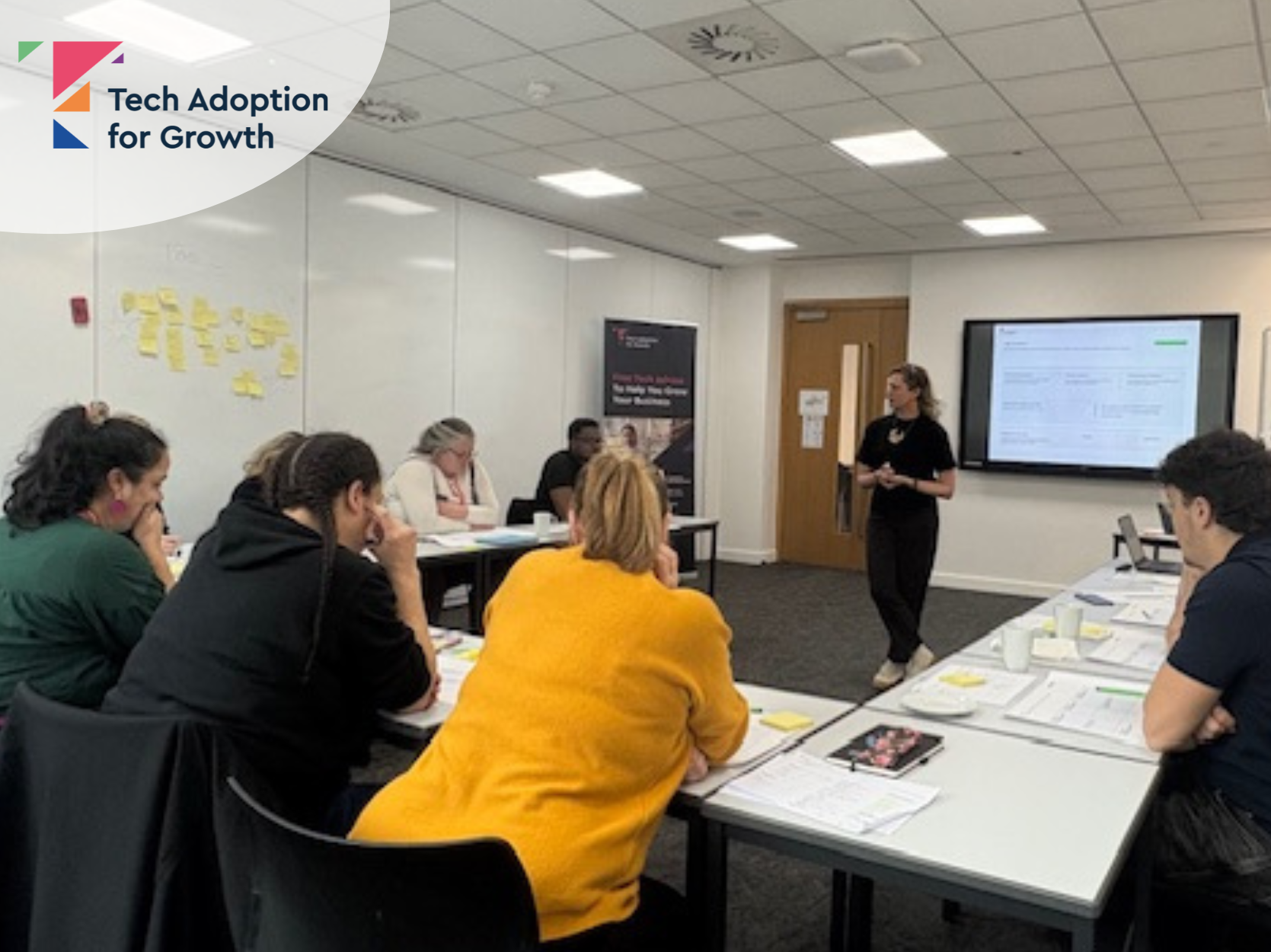
Tech Adoption for Growth is a new government-funded programme being trialled by Business West in the South West. It aims to help sole traders and small businesses become more efficient, productive and profitable through better use of digital technology. It’s an excellent programme. I’ve provided one-to-one consultancy services, for example, working with Sam Brown, founder and director of Bristol-based marketing agency Future Stories. Sam was quite an advanced AI user, she'd done lots of self-teaching, but wanted to make better use of AI in her business.”

What did that consultancy work involve and what benefits could it bring?

“We mapped out all the opportunities for her and her colleagues to use AI, to save time and money, enhance her services and offer new ones. Some of it was just to gain efficiencies. Some of it was to help improve quality. Guided by set goals, we looked at tasks and mapped them out to see where AI could make a difference. Sam was hugely excited, because she could identify tasks that she was previously doing manually or pulling across into AI but not quite getting the desired results, so we suggested tweaks. She's going to save an awful lot of time, but we even identified a couple of new services and ways to win new work. Hopefully, it will make a big difference.”

The idea is to explore how businesses can use AI to unlock time, improve efficiency and scale without adding headcount.

Finally, please tell us about the AI-themed podcast you host…

“It’s called Scaling with AI. We’ve produced about 25 episodes so far, based on practical conversations with AI experts, founders and business leaders who use AI to work smarter and grow faster. No hype or jargon, just plain English. The idea is to explore how businesses can use AI to unlock time, improve efficiency and scale without adding headcount. Each episode gives simple, actionable ideas that business owners can use straight away to make the most of the very many benefits AI can offer. I really enjoy hosting it.”


Tech Adoption for Growth is a government-funded pilot programme offering free, practical digital support to help SMEs and sole traders in the South West get far greater value from digital tools and technology so they can become more successful. Eligible businesses are randomly allocated to receive either one-to-one expert consultancy support or the opportunity to take part in expert-led tech-themed workshops. To apply fill out this simple form and we’ll get back to you.